Introduction#
I have lived in Vienna for over a decade. In that time, I have walked through Innere Stadt hundreds of times — on the way to work, on Sunday afternoons, on winter evenings when the streets are empty and the church towers disappear into low fog. And I still find it genuinely beautiful. That is not something you can say about the center of every city.
Innere Stadt — literally “inner city” — is Vienna’s 1st District and its historic heart. It sits roughly where the old city walls stood until the mid-19th century, when Emperor Franz Joseph ordered them torn down and replaced with the grand Ringstrasse boulevard that now wraps around the district like a frame. Inside that frame is a remarkably intact medieval and baroque city: cobblestone alleys, Habsburg palaces, imperial coffee houses, Gothic spires, and some of the best museums in Europe.
It is also, inevitably, crowded. The Graben on a summer Saturday afternoon feels like an airport departure lounge. Tourist menus with photos on the outside are everywhere around Stephansplatz. Prices are higher than anywhere else in Vienna.
None of that is a reason to avoid Innere Stadt. It is a reason to know how to move through it. This guide tells you exactly where to go, what to skip, and where to find the version of the 1st District that most visitors never see.
What Is Innere Stadt?#
Innere Stadt is Vienna’s smallest district by area — just 2.97 square kilometers — but its densest in terms of history and significance. The Roman fort of Vindobona stood here. The medieval city grew up around Stephansdom. The Habsburgs ruled their empire from the Hofburg for six centuries. Every layer of Viennese history is visible here if you know where to look.
Today the district is a mix of:
- Imperial landmarks — Hofburg, Stephansdom, the State Opera on the Ringstrasse edge
- High-end shopping streets — Kohlmarkt, Graben, Kärntner Strasse
- Museums — Albertina, Kunsthistorisches Museum (just outside on the Ring), Jewish Museum
- Traditional coffee houses — some of the finest in the city
- Quiet residential streets — Bäckerstrasse, Schönlaterngasse, the area around the Jesuitenkirche
- Hidden courtyards — Durchhäuser (passageways through buildings) that locals use as shortcuts
A note on who actually lives here: About 16,000 people are registered residents of Innere Stadt, making it Vienna’s least populated district. It is overwhelmingly offices, hotels, and cultural institutions. The Viennese who live here tend to be older, established, and very much attached to their address. If someone tells you their postcode is 1010, they want you to know.
Top Sights in Innere Stadt#
Stephansdom#
The Gothic cathedral at the center of Vienna is impossible to miss and impossible to overstate. The mosaic-tiled roof alone — 230,000 glazed terracotta tiles arranged in a heraldic pattern — is one of the most striking things I have seen on any building anywhere. It was restored after bombing in 1945 and still looks extraordinary.
Entry to the main nave is free, and you should go inside even if cathedrals are not usually your thing. The vaulted ceiling, the carved stone pulpit by Anton Pilgram, the baroque altarpieces — it is genuinely impressive. If you want to go further:
- South Tower climb: EUR 6, 343 steps, worth every step. The views over the old town rooftops are the best in the city at this height. Do it in the morning when the light is good.
- North Tower elevator: EUR 7 — skippable. The view is inferior to the South Tower.
- Catacombs tour: EUR 6.50, runs every 15–30 minutes. You see the bones of roughly 11,000 plague victims and the burial urns of the Habsburgs’ internal organs (their hearts are in the Augustinerkirche, their bodies in the Kaisergruft). Genuinely interesting and not as ghoulish as it sounds.
Address: Stephansplatz 3, 1010 Wien. Right at U1/U3 Stephansplatz. Hours: Cathedral 6:00–22:00 daily, towers and catacombs vary by season.
The Hofburg#
The Habsburg winter palace is not one building — it is a complex of 19 courtyards, 54 staircases, and 2,600 rooms assembled over six centuries. The part open to visitors includes the Imperial Apartments, the Sisi Museum, and the Imperial Silver Collection, all covered by a single ticket (EUR 17.50).
The Sisi Museum alone is worth the price. It does something rare: it takes one of the most romanticized figures in Austrian history — Empress Elisabeth, who became a pop culture icon thanks to the 1950s musicals — and shows you the real person. An obsessive dieter, a physical fitness fanatic, a woman deeply unhappy with the constraints of court life. The exhibit is nuanced and well-curated.
Hofburg Palace Guided Tour
Guided tours of the Hofburg cover the Imperial Apartments, the Sisi Museum, and the Imperial Silver Collection with expert commentary — a good way to navigate one of the largest palace complexes in Europe without missing the highlights.
Graben and Kohlmarkt#
Graben is Vienna’s main pedestrian street and its historical showpiece. It was once a moat (the name means “ditch”). Today it is a wide boulevard lined with high-end shops, outdoor café terraces in summer, and one of the most photographed sights in Vienna: the Pestsäule (Plague Column), a baroque monument erected in 1693 to mark the end of a bubonic plague epidemic that killed 75,000 people in the city.
Kohlmarkt connects Graben to the Michaelertor entrance of the Hofburg. It is arguably Vienna’s most prestigious shopping address — the local equivalent of Bond Street or the Rue du Faubourg Saint-Honoré. Demel, the imperial pastry house, is here at number 14. So is Meinl am Graben, one of the best food halls in the city.
What to do: Walk the length of both streets, look at the Pestsäule, duck into Demel for coffee and cake, and take the Michaelertor entrance into the Hofburg to see the archaeological excavations of the Roman fort visible under glass in the floor.
Am Hof#
Most visitors walk straight down Graben towards the Hofburg and miss Am Hof entirely. That is a mistake. Am Hof is a large baroque square a few minutes’ walk north of Graben, and it is one of the most beautiful spaces in the city. The Jesuit Church of Nine Choirs of Angels (Kirche Am Hof) on the eastern side is where Napoleon’s heralds proclaimed the dissolution of the Holy Roman Empire in 1806.
Today it hosts a weekly antiques and craft market on weekends, and the surrounding streets — Bognergasse, Naglergasse, Freyung — have a slower, more residential feel that the main tourist circuit never achieves.
Getting there: From the Pestsäule on Graben, head north on Bognergasse for 3 minutes.
Albertina#
The Albertina sits at the southeastern edge of Innere Stadt, overlooking the State Opera, and holds one of the greatest collections of graphic arts in the world — over 1 million prints and 65,000 drawings, including major works by Dürer, Raphael, Rembrandt, and Klimt. The permanent Batliner Collection, with its Impressionist and Modern art holdings (Monet, Picasso, Chagall), is consistently excellent.
- Price: EUR 21.90 for permanent collections
- Hours: Daily 10:00–18:00, Wednesdays until 21:00
- Address: Albertinaplatz 1, 1010 Wien
The State Opera (Staatsoper)#
The Vienna State Opera on the Ringstrasse is one of the world’s great opera houses, and attending a performance — even in the standing room section — is one of the genuinely distinctive things you can do in Vienna that you cannot replicate elsewhere.
Standing room tickets (Stehplatz) are sold from 80 minutes before curtain for EUR 4–10. You arrive, queue, get in, and spend the performance standing at the back of a ring tier with a small rail to lean on. The acoustics are extraordinary from up there. I have seen Verdi and Strauss from the fourth-floor standing rail for EUR 4, and it was magnificent.
Guided tours of the building run daily and are worth doing if you can’t attend a performance.
- Tour price: EUR 14
- Tour hours: Multiple times daily, check wiener-staatsoper.at for the schedule
Vienna State Opera Tour
Guided tours of the Vienna State Opera run multiple times daily and cover the auditorium, foyer, and backstage areas of one of the world’s great opera houses — worth doing if you cannot attend a performance.
Volksgarten#
On the western edge of Innere Stadt, tucked between the Hofburg and the Parliament building on the Ring, Volksgarten is Vienna’s oldest public park and one of its most elegant. The formal garden beds, neoclassical Temple of Theseus, and the Sissi monument make it look like something from a film set.
In summer, the Volksgarten Clubdiskothek operates out of the park and draws a mixed, young crowd to outdoor events. But on a quiet Tuesday morning, it’s just a beautiful garden where Viennese office workers eat their lunch in the sun. Free entry, always.
Where to Eat in Innere Stadt#
Let me be honest with you: a large proportion of the restaurants within 200 meters of Stephansplatz are tourist traps. Photo menus, multiple languages on the board outside, staff who approach you on the pavement — these are reliable red flags. Not all tourist-area restaurants are bad, but the ones that aggressively court foot traffic tend to serve food that capitalizes on location rather than quality.
Here is where I actually eat in the 1st District.
| Restaurant | What to Order | Price Range | Notes |
|---|---|---|---|
| Figlmüller Bäckerstrasse | Schnitzel | EUR 22–26 | The original location, smaller and more local-feeling |
| Zum Wohl | Wine and small plates | EUR 30–40 | Outstanding Austrian wine list |
| Tian | Vegetarian tasting menu | EUR 60–85 | Michelin-starred, the best vegetarian restaurant in the city |
| Meinl am Graben | Lunch, sandwiches, deli items | EUR 15–25 | High-end deli and restaurant above the food hall |
| Zanoni & Zanoni | Gelato | EUR 3–6 | Best ice cream in Innere Stadt, queue is part of the experience |
| Zum Wohl Wine Bar | Glasses of Grüner Veltliner | EUR 7–12 | Ground floor is casual, excellent Austrian producers |
Figlmüller Bäckerstrasse#
Most people know the Figlmüller on Wollzeile — it’s always in the guidebooks and always packed. The original location on Bäckerstrasse, a narrow alley a few minutes’ walk from Stephansplatz, is the better choice. The Schnitzel still hangs off the plate and is still among the best in Vienna. The room is smaller, the atmosphere slightly less theatrical, and the queue is shorter.
Address: Bäckerstrasse 6, 1010 Wien Hours: Mon–Sun 11:00–22:30
For more options, see my full guide to where to eat in Vienna and the best Schnitzel in Vienna.
Meinl am Graben#
The food hall on the ground floor of this Kohlmarkt/Graben institution is the best place to shop for Austrian food products in the city: excellent charcuterie, Austrian cheeses, local wines and spirits, housemade pastries. The restaurant upstairs is more expensive but the quality justifies it. For a lighter option, grab a sandwich from the deli counter and eat on the steps of the Pestsäule — Viennese office workers do exactly this every day.
Address: Graben 19, 1010 Wien
Zum Wohl#
A small wine bar in a narrow lane near the Jesuitenkirche, focused entirely on Austrian wine. The list is excellent — lots of growers from the Wachau, Kamptal, and Burgenland that you will not find on tourist-facing restaurant menus. Small plates of Austrian charcuterie and cheese pair with the wines. This is the kind of place where you end up staying two hours longer than planned.
Address: Riemergasse 10, 1010 Wien Hours: Mon–Sat from 17:00
Coffee Houses in the 1st District#
Innere Stadt has the highest concentration of historic Kaffeehäuser in Vienna. Three are essential.
Café Central#
The grand one. Vaulted ceilings, marble columns, a life-size figure of writer Peter Altenberg at the entrance, live piano from 17:00. The Apfelstrudel is very good, the Melange is solid. Go before 10:00 on a weekday to actually enjoy it.
Address: Herrengasse 14, 1010 Wien
Café Hawelka#
The opposite of grand. A dark, slightly cramped room near the Graben that has barely changed since the 1950s. Hawelka was Vienna’s bohemian coffee house — artists, writers, intellectuals. The Buchteln (warm yeast pastries with jam filling) come out only after 22:00 and sell out fast. Cash only.
Address: Dorotheergasse 6, 1010 Wien
Café Landtmann#
On the Ringstrasse at the edge of the 1st District, overlooking the Burgtheater. Freud’s favorite coffee house (he lived a short walk away on Berggasse). It is slightly more refined than Central without the same tourist density. The breakfast menu is excellent.
Address: Dr.-Karl-Lueger-Ring 4, 1010 Wien
For the full coffee house guide including prices, what to order, and lesser-known gems, see my best coffee houses in Vienna guide.
Where to Stay in Innere Stadt#
The 1st District is the most expensive place to stay in Vienna. You are paying for location, not necessarily for the rooms. That said, waking up a five-minute walk from Stephansdom has a genuine quality-of-life value if you are in Vienna for only two or three days.
My top picks at different price levels:
Luxury#
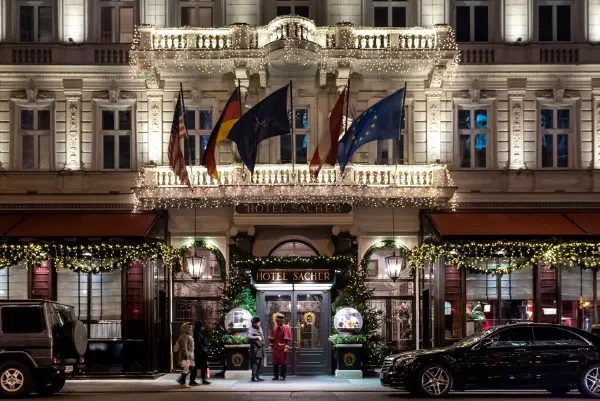
Hotel Sacher Vienna — The most famous hotel in Vienna, directly behind the State Opera. The rooms are traditional Habsburg-era in aesthetic, the service is polished, and the café is a Vienna institution. If you can afford it, there is nowhere more definitively Viennese to stay.
Check rates at Hotel Sacher on Booking.com
Hotel Imperial — On the Ringstrasse, former residence of Prince of Württemberg, turned into a hotel for the 1873 World Exhibition. Wagner and Mahler stayed here. The Imperial Torte (a marzipan and chocolate cake made exclusively for this hotel) is available in the café.
Check rates at Hotel Imperial on Booking.com
Mid-Range#
Steigenberger Hotel Herrenhof — Well-located on Herrengasse, a minute from Café Central and the Hofburg. Comfortable, classic rooms, reliable service.
Check rates at Steigenberger Herrenhof on Booking.com
Hotel Kärntnerhof — A smaller, family-run hotel near Stephansplatz. Quieter than the big chains, good personal service, central location.
Check rates at Hotel Kärntnerhof on Booking.com
For a broader range of options including neighborhoods outside Innere Stadt with better value, see my full where to stay in Vienna guide and my dedicated best hotels in Vienna’s city center roundup.
Hidden Corners Most Tourists Miss#
This is what separates the 1st District everyone visits from the one I know.
Schönlaterngasse and the Jesuitenviertel#
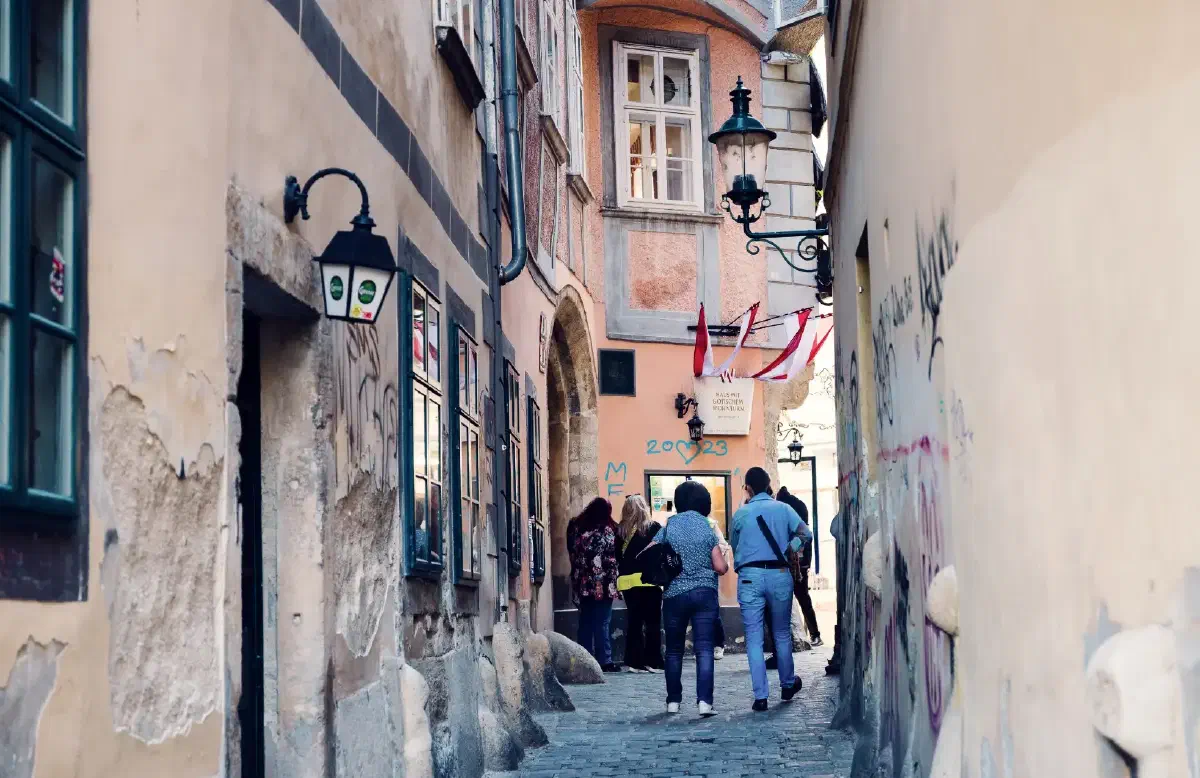
Two minutes east of Stephansdom, most visitors turn back toward the main pedestrian zone. If you continue instead down Schönlaterngasse (“beautiful lantern lane”) you find one of the most intact medieval street sections in Vienna. The Old Smithy at number 7 (still operating) claims to be one of the oldest continuously operating workshops in the city. The Jesuitenkirche at the end of the lane is worth stepping into — the trompe-l’oeil ceiling is one of the great optical illusions in Viennese architecture, painted to look like a barrel-vaulted ceiling where there is in fact a flat one.
The Durchhäuser#
Vienna’s 1st District is threaded with Durchhäuser — covered passageways that cut through city blocks, connecting one street to the next. Locals use them as shortcuts; tourists almost never find them. Particularly good examples: the passage from Graben through Habsburgergasse to Kohlmarkt, and the multiple passages in the block between Wollzeile and Sonnenfelsgasse. Some have small shops or coffee stands inside. None are marked on most tourist maps.
Ruprechtskirche and the Area Around It#
The Ruprechtskirche, tucked against the old city wall foundations near the Danube Canal, is the oldest church in Vienna — parts of it date to the 8th century. The surrounding neighborhood around Seitenstettengasse (where the Vienna synagogue stands, invisible from the outside for historical reasons) and Judengasse has a quieter, slightly grittier feel than the rest of Innere Stadt. The wine bar area around Rabensteig fills with locals on warm evenings.
Peterskirche Interior#
Most people see St. Peter’s Church (Peterskirche) from the outside as they walk down Graben — it is the smaller baroque church just before the Pestsäule, designed partly in reference to St. Peter’s in Rome. Almost no one goes inside. The interior is a masterwork of high baroque: deep red and gold, an oval nave, painted ceilings, and a reliquary that contains the remains of a Roman martyr. Free entry. Rarely crowded.
Dorotheergasse#
The short lane connecting Graben to the Augustinerstrasse is one of my favorite streets in the city. It holds Café Hawelka, the Dorotheum auction house (one of the oldest and largest in the world — you can browse their sales rooms for free), and the Jewish Museum Vienna. The contrast between these institutions, crammed into a single narrow lane, feels very Viennese.
Suggested Walking Route#
This route covers the essential Innere Stadt in roughly three to four hours at a comfortable pace, with coffee and a stop for lunch built in.
- Start: Stephansplatz (U1/U3). Go inside Stephansdom. If you want the tower view, climb the South Tower now before the crowds.
- Walk north up Rotenturmstrasse, then turn left onto the Hoher Markt — Vienna’s oldest square, site of a Roman legionary camp. See the Anker Clock (Ankeruhr), a Jugendstil astronomical clock whose figures parade at noon.
- Continue west on Tuchlauben to Am Hof square. Walk around the square, duck into a Durchhaus to Bognergasse, and emerge on Freyung.
- South on Herrengasse past the Landhaus and Café Central. Stop for a Melange and Apfelstrudel.
- Continue south through the Michaelertor into the Hofburg courtyard. Walk through toward the Burggarten.
- Exit onto Albertinaplatz. The Albertina is here if you have the budget and the energy. Otherwise continue east.
- East along Kärntner Strasse (the pedestrian shopping street) back toward Stephansplatz.
- Detour: Turn left on Dorotheergasse to see Hawelka and the Dorotheum, then cut through to Graben. Walk east on Graben, stopping at the Pestsäule.
- Turn south on Bäckerstrasse for lunch at Figlmüller.
- Explore: Head into Schönlaterngasse, find the Jesuitenkirche and the trompe-l’oeil ceiling. Then back to Stephansplatz.
Total walking distance: Approximately 4–5 km, depending on detours.
Practical Information#
Getting There#
Innere Stadt is the easiest district to reach in Vienna. The U1 and U3 both stop at Stephansplatz, right in the center. The U3 also stops at Herrengasse (good for the Hofburg area) and at Stubentor (good for the eastern part of the district near the Stadtpark). Tram lines D, 1, 2, and 71 run along the Ringstrasse and stop at the main Ringstrasse institutions (Opera, Parliament, Rathaus).
From the airport: The City Airport Train (CAT) goes to Wien Mitte/Landstrasse in 16 minutes (EUR 14.90 one way); from there it’s one stop on U3 to Stephansplatz. The S-Bahn (S7) takes 30 minutes for EUR 4.20. See my Vienna airport to city center guide for full options.
How Long to Spend#
| Visit type | Recommended time |
|---|---|
| First-time visitor, sightseeing focus | 1 full day |
| Museum focus (Albertina + Hofburg) | 1.5 days |
| Relaxed exploration with coffee houses | 2 days |
| Staying in the district | 3+ days gives you mornings before crowds |
Best Time to Visit#
Time of day: Early morning (before 9:30) is the best time to be in Innere Stadt. The Graben is empty, the coffee houses are quiet, and the light on the cathedral is beautiful. After 11:00 in summer the tourist density rises sharply.
Season: Spring (April–May) and autumn (September–October) are the most pleasant — good weather without the peak July–August crowds. Winter is underrated: the Christkindlmarkt on Rathausplatz draws big crowds, but the 1st District streets themselves are often quiet on weekday mornings and genuinely atmospheric.
Avoid: Graben and Kärntner Strasse on Saturday afternoons in July and August. Not unsafe, just unpleasant.
Costs to Budget#
| Item | Cost |
|---|---|
| Stephansdom South Tower | EUR 6 |
| Hofburg (Imperial Apartments + Sisi Museum) | EUR 17.50 |
| Albertina (permanent collection) | EUR 21.90 |
| State Opera guided tour | EUR 14 |
| State Opera standing room (Stehplatz) | EUR 4–10 |
| Coffee + cake at Café Central | EUR 12–15 |
| Schnitzel at Figlmüller | EUR 22–26 |
Is Innere Stadt Worth It?#
Every time I am asked this, I pause. Because the question usually comes from someone who has seen the prices and the crowds and is wondering whether to stay in the 7th or 8th District instead and commute in. And my honest answer is: for most visitors, staying outside Innere Stadt and coming in for the sights is completely reasonable. The district’s location premium is real.
But experiencing the 1st District is not negotiable. You cannot visit Vienna and skip it. Stephansdom, the Hofburg, the coffee houses, the baroque streets — this is where Vienna’s identity was built, and it is still the most concentrated expression of what the city is. Walk it properly. Eat in the right places. Go early. Find the Jesuitenkirche.
Done right, Innere Stadt is not a tourist trap. It is the reason Vienna is worth the trip.
Frequently Asked Questions#
Is Innere Stadt worth visiting in Vienna?#
Yes — you cannot visit Vienna and skip it. Stephansdom, the Hofburg, the coffee houses, and the baroque streets are the most concentrated expression of what the city is. The key is knowing how to move through it: go early in the morning, eat away from the main pedestrian zone, and explore the side streets and hidden courtyards that most visitors never find.
How long do you need to explore Innere Stadt?#
A first-time visitor should budget one full day for a sightseeing focus — Stephansdom, the Hofburg, Graben, Kohlmarkt, and a coffee house stop. If you want to visit the Albertina and Hofburg properly, allow 1.5 days. For a relaxed exploration with multiple coffee house stops and a proper sit-down lunch, two days is ideal.
What is the best time to visit Innere Stadt?#
Early morning before 9:30 is the best time to be in Innere Stadt. The Graben is empty, the coffee houses are quiet, and the light on Stephansdom is beautiful. By 11:00 in summer the tourist density rises sharply. For seasons, spring (April–May) and autumn (September–October) offer the best combination of pleasant weather and manageable crowds.
Where should I eat in Innere Stadt?#
Avoid any restaurant within 200 meters of Stephansplatz that has photos on the menu — these capitalize on location rather than quality. For schnitzel, go to Figlmüller Bäckerstrasse. For a deli lunch, Meinl am Graben. For Austrian wine and small plates, Zum Wohl on Riemergasse. For coffee, visit Café Hawelka or Café Central before 10:00 on a weekday.
Is it worth staying in Innere Stadt?#
For most visitors, staying outside Innere Stadt — in the 7th or 8th district — and commuting in is completely reasonable and 30–40% cheaper. But staying in the 1st district gives you access to the streets before the crowds arrive, which is a genuine advantage if your budget allows it. Hotels like Hotel Kärntnerhof offer reasonable mid-range rates with a central location.
Is Innere Stadt worth visiting in Vienna in 2026?#
Yes — in 2026 it remains the essential starting point for any Vienna first visit. The Stephansdom South Tower costs EUR 6, the Hofburg Imperial Apartments and Sisi Museum cost EUR 17.50, and State Opera standing-room tickets are just EUR 4–10. Many of the best experiences — the Volksgarten, the Durchhäuser passageways, the Peterskirche interior, the Jesuitenkirche trompe-l’oeil ceiling — are completely free.
What is the best free thing to do in Innere Stadt Vienna in 2026?#
The best free experiences in Innere Stadt in 2026 are: the Peterskirche interior on Graben (a high baroque masterwork that is almost never crowded), the Volksgarten rose garden on the western edge of the district, and the Durchhäuser passageways that cut through city blocks like secret shortcuts. The Ruprechtskirche near the Danube Canal — Vienna’s oldest church, parts of it dating to the 8th century — is also free to enter and usually quiet.
How far is Innere Stadt from Schoenbrunn Palace?#
Schoenbrunn Palace is approximately 4.5 km from Stephansplatz. The easiest route is the U3 metro from Stephansplatz to Westbahnhof (4 stops, about 8 minutes), then the U4 one stop to Schoenbrunn station — a total journey of about 20 minutes. Taxis and rideshare take 10–15 minutes depending on traffic. It is a perfectly practical half-day combination: Innere Stadt in the morning, Schoenbrunn after lunch.
What to Do Next#
Ready to plan your full Vienna visit? Here is where to go from here:
- Full trip plan: 3-Day Vienna Itinerary — a day-by-day breakdown with Innere Stadt on Day 1
- All the sights: 25 Best Things to Do in Vienna — covers the whole city beyond the 1st District
- Where to eat: Where to Eat in Vienna — restaurants across all districts and price ranges
- Hotels: Best Hotels in Vienna City Center — curated options in and around the 1st District
- Coffee: Best Coffee Houses in Vienna — the complete guide to Kaffeehaus culture